Summary / Overview
- Acne vulgaris is a chronic inflammatory disorder of the pilosebaceous unit
- Primarily affects face, chest, shoulders, and back where sebaceous glands are dense.
- Most common during adolescence due to androgen-driven sebaceous activity
- Can persist into adulthood, especially in females.
- Characterized by comedones, papules, pustules, nodules, and possible scarring
- Severity ranges from mild cosmetic concern to severe inflammatory disease.
Etiology
- Androgen-driven sebaceous gland hyperactivity is the primary trigger
- Increased androgen sensitivity during puberty stimulates excess sebum production.
- Follicular hyperkeratinization leads to comedone formation
- Abnormal keratinocyte shedding blocks the pilosebaceous duct.
- Cutibacterium acnes colonization contributes to inflammation
- Bacterial proliferation within blocked follicles activates immune response.
- Genetic predisposition influences severity and persistence
Pathogenesis
- Sebaceous gland hyperactivity increases sebum production within pilosebaceous units
- Androgen stimulation causes enlargement and increased activity of sebaceous glands.
- Follicular hyperkeratinization blocks the pilosebaceous duct → microcomedone formation
- Keratinocyte proliferation and impaired shedding obstruct follicular outflow.
- Sebum accumulation creates an anaerobic environment favoring Cutibacterium acnes growth
- Bacterial proliferation occurs within the blocked follicle.
- Cutibacterium acnes activates innate immune response
- Triggers release of cytokines (IL-1β, IL-8, TNF-α) and inflammatory mediators.
Symptoms
No key-points marked yet. Add lines like *Important point* in this section.
Signs
No key-points marked yet. Add lines like *Important point* in this section.
Clinical Features
No key-points marked yet. Add lines like *Important point* in this section.
Investigations
No key-points marked yet. Add lines like *Important point* in this section.
Differential Diagnosis
No key-points marked yet. Add lines like *Important point* in this section.
Occurs predominantly in adolescents due to androgen-driven sebaceous activity
Peak onset at puberty; may persist into adulthood.
Lesions evolve from comedonal to inflammatory stages
Blackheads/whiteheads → papules → pustules → nodules/cysts.
Sebaceous-rich areas are primarily involved
Face, chest, upper back, and shoulders.
Severity ranges from mild comedonal acne to severe nodulocystic disease
Extent depends on inflammation and follicular obstruction.
Flares associated with hormonal influence
Premenstrual exacerbation common in females.
Psychological impact is significant
Low self-esteem, anxiety, social withdrawal.
Chronic course with relapses
Periods of improvement followed by flare-ups.
Post-inflammatory hyperpigmentation and scarring common in moderate–severe disease
May persist long after active lesions resolve.
Adult acne may present with jawline and chin predominance
Often associated with hormonal imbalance or stress.
Rosacea may mimic acne but lacks comedones
Facial erythema, telangiectasia, papules/pustules in adults; burning sensation common.
Folliculitis presents with uniform pustules without comedones
Often bacterial or fungal; lesions centered on hair follicles.
Perioral dermatitis causes papules around mouth and nasolabial folds
Common in steroid users; sparing of vermilion border.
Drug-induced acne (acneiform eruption)
Triggered by steroids, lithium, antiepileptics, antitubercular drugs; monomorphic lesions.
Sebaceous hyperplasia appears as yellowish papules with central umbilication
Seen in adults; no inflammatory component.
Hidradenitis suppurativa affects axilla/groin with nodules and sinus tracts
Chronic, painful, scarring disease of apocrine glands.
Milia present as small white keratin cysts
Non-inflammatory; commonly around eyes and cheeks.
Gram-negative folliculitis in patients on long-term antibiotics
Sudden flare of pustular lesions.
Keratosis pilaris causes follicular papules on arms/thighs
Rough skin texture; non-inflammatory.
Lupus miliaris disseminatus faciei
Papules on face with scarring; no comedones.
Presence of comedones (open/closed) remains the key feature distinguishing acne vulgaris from most mimickers.
Androgen-driven sebaceous gland hyperactivity is the primary trigger
Increased androgen sensitivity during puberty stimulates excess sebum production.
Follicular hyperkeratinization leads to comedone formation
Abnormal keratinocyte shedding blocks the pilosebaceous duct.
Cutibacterium acnes colonization contributes to inflammation
Bacterial proliferation within blocked follicles activates immune response.
Genetic predisposition influences severity and persistence
Family history increases likelihood of moderate to severe acne.
Hormonal fluctuations worsen acne
Menstrual cycle changes, PCOS, pregnancy, and endocrine disorders may aggravate lesions.
Dietary factors may exacerbate acne in susceptible individuals
High glycemic load and dairy products are implicated in some studies.
Certain medications can induce or worsen acne
Corticosteroids, anabolic steroids, lithium, phenytoin, and some hormonal agents.
Occlusive cosmetics and mechanical friction may aggravate lesions
Comedogenic products and tight clothing can worsen follicular blockage.
Diagnosis is primarily clinical; no routine laboratory tests are required
History and physical examination are sufficient in most cases.
Hormonal evaluation is indicated in suspected hyperandrogenism
Consider in females with irregular menses, hirsutism, or resistant acne.
Recommended tests when indicated:
• Serum total and free testosterone
• DHEAS
• LH / FSH ratio
• Prolactin
• Thyroid profile
Polycystic ovary syndrome (PCOS) should be excluded in appropriate cases
Pelvic ultrasound may be advised if clinical suspicion exists.
Bacterial culture is not routinely required
May be considered in severe, treatment-resistant, or atypical lesions.
Metabolic evaluation may be needed in obese patients
Fasting glucose and lipid profile if metabolic syndrome suspected.
In typical adolescent acne without systemic features, investigations are usually unnecessary.
Sebaceous gland hyperactivity increases sebum production within pilosebaceous units
Androgen stimulation causes enlargement and increased activity of sebaceous glands.
Follicular hyperkeratinization blocks the pilosebaceous duct → microcomedone formation
Keratinocyte proliferation and impaired shedding obstruct follicular outflow.
Sebum accumulation creates an anaerobic environment favoring Cutibacterium acnes growth
Bacterial proliferation occurs within the blocked follicle.
Cutibacterium acnes activates innate immune response
Triggers release of cytokines (IL-1β, IL-8, TNF-α) and inflammatory mediators.
Inflammation leads to papules, pustules, and nodules
Neutrophil infiltration and follicular wall rupture spread inflammation to surrounding dermis.
Comedone evolution produces open (blackhead) and closed (whitehead) lesions
Oxidation of melanin and lipids forms blackheads; closed follicles form whiteheads.
Severe inflammation damages dermal collagen → acne scarring
Fibrosis and tissue remodeling lead to permanent scars.
Hormonal changes, genetic susceptibility, and environmental triggers modulate disease severity and chronicity.
Open comedones (blackheads) are non-inflammatory follicular plugs
Dark color is due to oxidation of melanin and lipids, not dirt.
Closed comedones (whiteheads) are small, skin-colored papules
Result from complete follicular obstruction beneath the epidermis.
Inflammatory papules and pustules indicate active immune response
Erythematous lesions with central purulent content.
Nodules and cysts represent deep dermal inflammation
Painful, firm lesions with higher risk of scarring.
Seborrhea (oily skin) reflects increased sebaceous gland activity
Commonly seen on face, chest, and upper back.
Post-inflammatory hyperpigmentation occurs after lesion resolution
More common in darker skin types.
Acne scars (atrophic or hypertrophic) indicate previous severe inflammation
Includes ice-pick, boxcar, rolling scars, or keloid formation.
Distribution is symmetrical over sebaceous-rich areas
Face (T-zone), chest, shoulders, and upper back are typically involved.
Acne vulgaris is a chronic inflammatory disorder of the pilosebaceous unit
Primarily affects face, chest, shoulders, and back where sebaceous glands are dense.
Most common during adolescence due to androgen-driven sebaceous activity
Can persist into adulthood, especially in females.
Characterized by comedones, papules, pustules, nodules, and possible scarring
Severity ranges from mild cosmetic concern to severe inflammatory disease.
Multifactorial pathogenesis
Includes follicular hyperkeratinization, excess sebum, Cutibacterium acnes proliferation, and inflammation.
Psychological impact can be significant
May lead to anxiety, low self-esteem, and social withdrawal
References
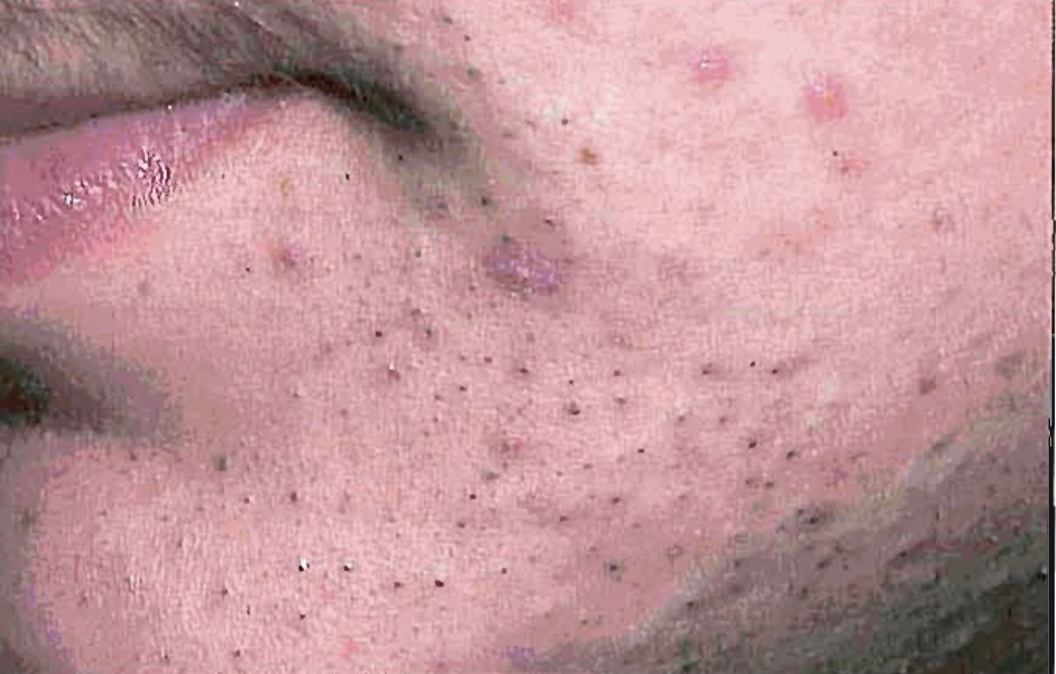
Acne vulgaris
2026-02-20 03:31:50
Gradual onset of facial eruptions during adolescence or early adulthood
Often begins around puberty with progressive skin changes.
Appearance of blackheads and whiteheads (comedones)
Patients notice rough skin texture and clogged pores.
Red, inflamed pimples (papules and pustules)
Commonly associated with tenderness and cosmetic concern.
Painful deep nodules in severe acne
May interfere with daily activities and cause distress.
Oily skin (seborrhea)
Excess sebum production gives a shiny, greasy appearance.
Lesions commonly involve face, chest, shoulders, and upper back
Distribution corresponds to areas rich in sebaceous glands.
Post-inflammatory pigmentation and marks after healing
Dark spots remain even after lesions resolve.
Psychological symptoms: embarrassment, anxiety, low self-esteem
Cosmetic impact significantly affects adolescents and young adults.
Tap a card to view full section
Use the coloured cards above (Etiology, Symptoms, Treatment, etc.).